Thursday, 9 June 2016

Music Video Questionnaire

In order to gain an understanding of what audiences wanted to see in a music video, I created a quantitive questionnaire and gave it to each student in my class. The questionnaire garnered a mixed bag of results and in general I did not find it to be very helpful in the creation of my video. However, in some instances such as when they were asked whether they preferred fast and energetic or slow paced music videos, the majority of the group (72%) answered that they preferred a mixture of the two. Fortunately I had already made plans to use a mixture of shot lengths and alternating speeds of on-screen movement. But on the other hand, this feedback did get me thinking about how important making sure the visuals matched the pace of the music was in terms of the videos overall effectiveness. Pacing can be one of the most important aspects to consider when producing a music video as otherwise you could run the risk of losing your audiences interest. While editing I still had to re-cut scenes in my video a few times in order to improve the pace. I found it somewhat difficult to edit some of the footage such as that of the ferrofluid. This was due to its rather slow nature in comparison to the portion of the song I wanted to use it in. To overcome this problem I sped 


The participants were also asked about their favourite music video and why they enjoyed it. This gave me the following responses:
  1. The 1975 - A Change of Heart because of the intertextuality and the references to previous songs and music videos.  And also it has dancing clowns.
  2. One direction - History. I think the difference between the narrative and performance.
  3. Bts-I need U (19+ ver.) because so much happens it's more than just dancing and singing, it tells a story and it's a little bit scary. 
  4. L$D - Asap Rocky. (No explanation)
  5. Honey - Moose Blood. Because I like how it has a narrative, how the artists make an appearance and how it's almost parody-like 
  6. Michael Jackson - Thriller. The story, performance, and costume.
  7. Alt-J - Every Other Freckle. Because it gives a very loose narrative but is very experimental 
  8. Chico - Chico Time. Inspirational.
  9. Michael Jackson's - "Thriller". The zombies dancing, Michael's charisma, the song itself, the cinematography, playfulness.
Most of the responses above listed the inclusion of a narrative as one of the reasons for their music video choice. However, I have already decided upon and planned to not shoot a plot driven sequence, instead opting for a more symbolic and experimental piece. I believe the reason for the interest in narrative is that it makes the audience eager for answers. The anticipation of a conclusion to a complication allows the audience to become invested. Often the music video narrative will mirror and pay homage to a genre of film. A widely recognised example being Michael Jackson's "Thriller" of which is heavily inspired by horror films and was even directed by horror director John Landis. 


In order to gain a good, solid understanding of what audiences want from a music video, I decided to create a questionnaire and send it to the other students in my class to fill out. This method of research is called quantitative, as it relies on facts and figures, whereas the other methods of research were more qualitative, which  produces more varied and in depth results. Quantitative research methods are more structured ways of getting information and they produce solid information in a formal, often numerical manner.

The purpose of the questionnaire I created was to gain an insight into what an audience prefer a music video to include and to find out their thoughts and opinions. 


I had hoped that my questionnaire would provide me with lots of data that would help inform my work and give me some ideas and inspiration, however, this proved not to be necessarily the case. This is because not all of the answers I received from the questionnaire were in as much detail as I would have liked, with some of the replies being very short. Another reason why I did not get the quality of information that I had hoped for could have been due to the fact that a lot of the questions had multiple choice answers and some people may have found it difficult to choose an accurate answer, or even didn't have an answer that reflected their own opinion at all. As a result of this, I believe that the reliability of my results may be questionable, but I am glad I conducted this method of research because it gave me some idea of what kind of video audiences enjoy watching. 

Music Video Edit Decision List


Music Video Evaluation

Music Video Evaluation

Pre-production

Intended to shoot some moving ferrofluid. Inspired by The Girl with the Dragon Tattoo opening title sequence. This sequence has a gothic horror vibe to it. The fluid is evocative of death and aliens.
Footage of fluid moving, ink, oil and glitter/acrylic paint in water.

I ultimately decided upon Guilt Trip by Kanye as I felt it best suited the visuals I had in my head.
I desired to have a one-point-perspective shot from the front view of my car travelling along the A5 towards Dordon. I had travelled a lot down this road in the past year while visiting my close friends who all live there. Seeing the beauty of this road often, I knew this was going to be a desired shot long before we started the music video unit.
I wanted to make a piece that had some connection to my experiences over the last year.
The song is about trying to figure out why his relationships have gone wrong. I see the video as an expression of escapism from reality.

Production
I carried out three separate shoots of a mixture of fluids. I purchased some ferrofluid and borrowed a couple magnets from the physics department. In order to carrying out some more diverse experiments I tried to extract some fluorescent fluid from some glow sticks. However, that proved to be more difficult than I had anticipated and I didn't have enough time to go to plan B which was to extract and melt down some highlighter fluid. So instead I decided to just shoot the ferrofluid on its own and fortunately I think the footage turned out better than I had anticipated regardless. I attached the GoPro to the front grill of my car using a car attachment I bought offline. We went to Earls Shilton skate park with A2 student Cal Dawson. I was told by a friend that he was a proficient at skateboarding so I decided to get in touch to see if he could be apart of the video. I tested out the attachment prior to installing the GoPro to ensure it would be safe to use while driving.

Post-Production
I decided to go with the 2.35:1 anamorphic aspect ratio to give the piece a cinematic quality. The one point perspective of the road shot transitions into the light vortex well. it goes with the line: "I'm losing my... Im living my..."- these lyrics convey a story or purpose behind the visuals. The flashing psychedelic liquid sequence was inspired by West's own video for his other song 'All Of The Lights'. The overlay of the imagery was inspired by the editing of Locke starring Tom Hardy. I see the purpose of the video as a response to a guilt trip - when someone tries to make you feel guilty for thinking/feeling/doing things a certain way. Its a visual representation of the act of taking illicit substances in an attempt to escape feelings of guilt and existential worries. During editing, I wondered if the lack of a close-up to create an attachment to a central figure was missing. However I think the result is instead a video that makes it seam as though it were from the audiences own perspective. I wish in heinsight I had used a two camera setup as it would then have had the opportunity to be viewed in 3D via a VR headset, making it a more immersive experience. The ferro fluid footage was actually edited the same colour hue as the fluid seen in David Finchers title credits.

Music Video Editing


Wednesday, 8 June 2016

"Guilt Trip" Music Video


Guilt Trip Unofficial Video by ethancoledelaney

Music Video Planning

The planning for my music video has gone through multiple changes in regards to music selection and themes. I was given the opportunity to create a music video for a students band, however decided not to do so due to feeling as though it would alter the creative direction I wanted to go in. Initially I had intended to shoot a music video to a different Kanye West song titled 'Fade' feat. Post Malone and Ty Dolla $ign. I felt as though a Kanye West song would be a good starting point as I knew I wanted to create a video with a lot of energy and also felt that picking a bold artist such as Mr. West would make my video somewhat distinctive from my peers'. However, upon picking this electronic/dance influenced song I quickly became aware of many potential difficulties.

The first problem being the multiple instances of profane language. While I believe it adds to the authentic expression of emotion within the song, I knew that the video would be potentially viewed by future students and parents/guardians of such that could find it off-putting and offensive. While this was not necessarily the deciding factor upon why I ditched the song, as I considered censoring these instances, the song also seemed to be too repetitous and not substantial enough to justify its length. I felt as though the video could risk becoming somewhat boring because of this.

Finaly, after having imagined visuals that I desired to see in my video, I beleived that the pace and feeling of the song did not match this and so therefore decided to drop the song from the process. Unfortunately this wasted some otherwise useful time I could've spent developing my current idea. Swifty, I tried to search for an alternate song ranging from the likes of Daft Punk, Radiohead, Arcade Fire and even Death Grips to no luck for a few days. That was until I stumbled upon another Kanye West song titled 'Guilt Trip' from his 2013 album Yeezus. This song is very erratic and digital in nature and so I therefore plan on producing visuals combined with editing techniques that suit these qualities. After listening to the songs synth instrumental, the image of ferrofluid, a fluid containing a magnetic suspension, came to mind. I had previously seen the fluid used in the incredible opening title credits to David Fincher's remake of The Girl with the Dragon Tattoo and more recently in Lady Gaga's Fame perfume ad campaign. 


I have chosen the idea of procrastination as a theme for the video (a subject I know only too well!) and a sence of escapism from reality via different experimental methods. It's the methods in particular that I want to keep unconfirmed due to their problematic nature, so this is one reason as to why my video will be experimental in nature; to both imply but not necassarily confirm the meaning behind some shots. I also strongly feel that this theme would suit a lot of my desired imagery as it is will be primarily shot from a first person perspective. To expand upon this, I plan on manipulating a lot of my imagery in Adobe After Effects in order to give the illusion of an altered reality.

Inspirational overlay editing technique in Locke
In regards to editing, I plan on overlaying some imagery in the style of the instances in the film Locke starring Tom Hardy (left). This display of two separate images can create a sense of the distortion of time and space - an effect that I hope to achieve within the audience as though they were experiencing the escapism for themselves.

First makeshift attempt at
filming the oil.
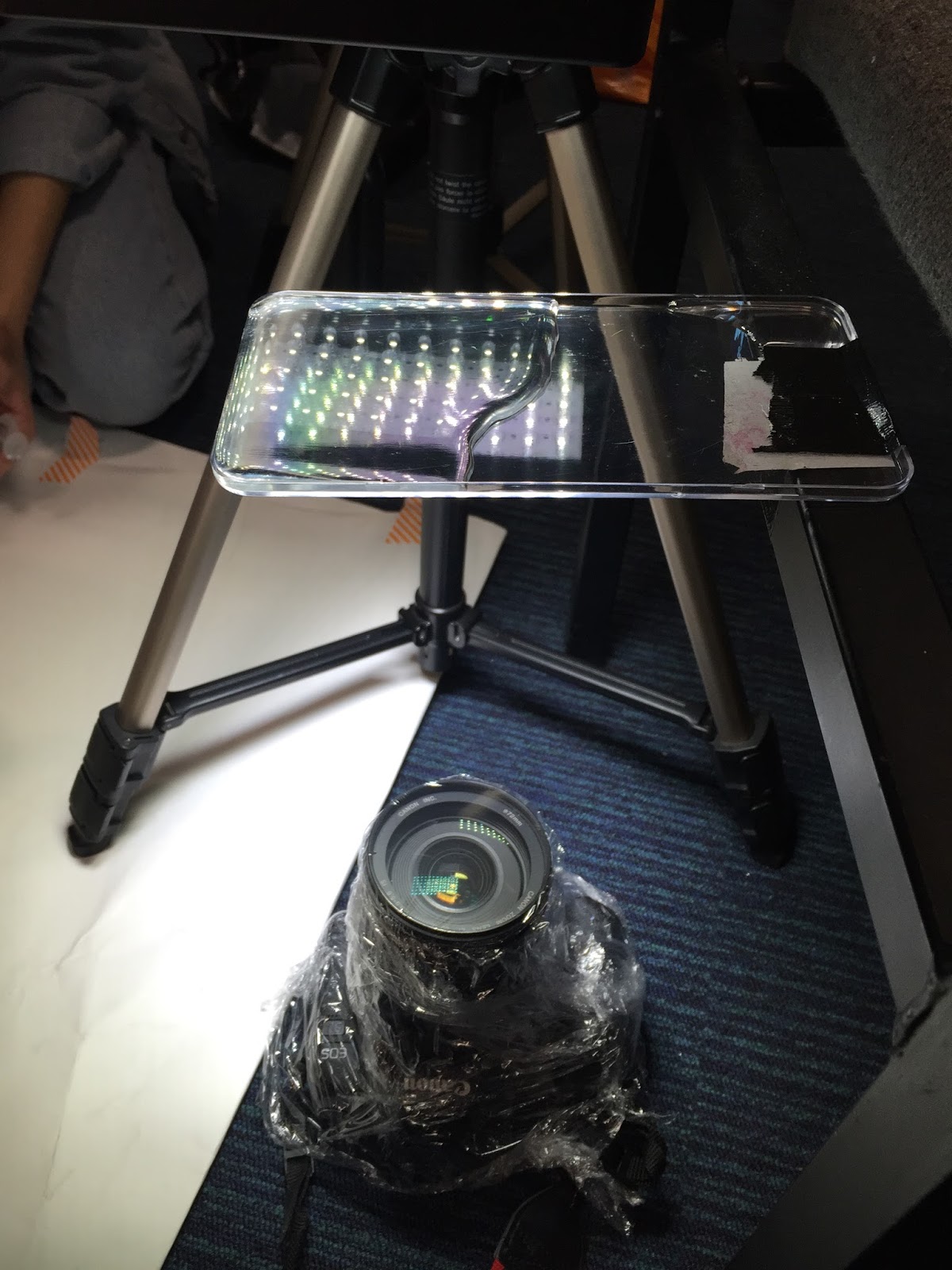
A couple months ago, I helped my friend (a Foundation Art student at my college) shoot some footage of flowing oil and ink in different liquids in order to achieve a psychedlic asthetic. I used the college equipment such as a macro lens, tripod and Canon 650D to capture the close up imagery and later incorporated this into a video demonstrating editing visuals to music. After seeing the huge potential of shooting and editing psychedelic art to music, this has now become a basis for my video's imagery.


Once I have shot some of the video, additional ideas may come to mind as it starts to take shape.
I plan to shoot in as high of a shutter speed as possible to ensure I can slow down any footage without compromising 25fps in post-production if the need arises.


Thursday, 26 May 2016

Continuity Editing - Video


Fellow students, Celia Ward and Lalita Ajit and I decided to shoot and edit our "Continuity Editing" video together. The purpose of the video is to demonstrate how continuity between clips can be achieved via specific juxtaposition of shots.

Editing To Audio

Editing video to audio can help to create a more immersive experience. Aligning cuts with audio can either emphasise or better conceal the edit.

For this task I decided to shoot some footage of oil in water and edit it to Tame Impala's song 'New Person, Same Old Mistakes'.

Research Techniques Quiz

Music Video Analysis (Arcade Fire - Afterlife)

This video was written and directed by filmmaker/photographer Emily Kai Bock

Intertextuality
Possibly inspired by the cinematography of the french sci-fi film La Jetee:


Arcade Fire - Afterlife
Chris Marker - La Jetee

Narrative
Three characters - two sons and a father dealing with the death? of the mother.
Father is seemingly rather poor given his job of passing out flowers on the street.
We see the different dreams of all of the males.

Cinematography
Some scenes are in black and white some are not. Those in black and white likely show the past with the mother present. It would appear as though the father is visiting her in a dream as we see him fall asleep. In contrast to the dark low key lit dream, the memories of his wife are high key.
The colours are muted in the first minute and a half - they don't have much impact. Its as if they don't have much life. Dull.

We're unable to see the mothers whole face - loss of identity - she has being a memory

Illustration
it was just a glymps of you like looking through a window

Amplification
As the music starts to fade at the end of the song, so does the light coming through the windows of the basement.
The camera slowly pulls back revealing more of their home as the music starts to play.
The man literally goes towards "the light" - towards the afterlife

Costume:
Oldest child wears a red hoodie - at risk of danger? Susceptible to danger?


The boy bangs on the glass of the washing machine as the drum beats occur

The music is preluded by one and a half minutes of narrative which shows the father at work and at home having a quite meal with his two sons. It is clear that their seems to be something wrong due to the tension of their conversation. A fourth chair at the table is empty suggesting that perhaps their mother is not present.

Edits occasionally occur during a change in the song - for example if a new line, verse or instrumental portion is introduced - keeps the video snapy and insync as it were with the visuals - the visuals feel more to the pace of the music.

Music Video Analysis (Michael Jackson - Bad)


The music video for Michael Jackson's 'Bad' is one of the most iconic of all time. Directed by the now legendary filmmaker Martin Scorsese, this short film draws from a variety of influences to Jackson. Jackson surrounded by a street gang pose, dance around a Brooklyn subway station referencing the "cool" sequence choreography of West Side Story

Dance-pop genre
Sound effects are included to emphasise the dance moves and amplify the music.
The video above is just the music portion of the 18 minute long film.

Intertextuality:
West side story
The lyric "shaman" is a reference to Marvis Staples, an American gospel singer.
Inspired dance moves of James Brown

Amplification
The shot of Michael snapping his fingers together is accompanied by a sound effect and signifies the start of the music. The visuals of Michaels gang carrying out illegal acts such as spray painting amplifies the lyrics of him being "bad" - New York at the time was one of the highest areas of crime in the US and this video reflected that aspect of the city.

Purpose of the video:
Demonstrate Michael's more edgy and aggressive style of song and dance.

Momentum
edits are often made on the beat of the music
choreography is in time to the music

Cinematography
Lighting is of a primarily medium key.
Colours are grey, black muted.
Lots of artist close-ups: Michael looks good in punk inspired clothing, he does not play a celebrity in the piece but does give a notable wink to the fact that he is by breaking the fourth wall and often looking at the camera
Low angle shot to emphasise his position of authority/supremacy

Comedy
many funny moments e.i "you gonna dance us to death?"
the idea that they are dancing in a confrontation - what MJ can do best

Racial diversity - represents New York

Masculinity is a focus - there are no women in the video.

Costume
This type of urban clothing reflects the environment they're in.

Voyeurism
We see these gang members dance in formation while in a confrontation (extremely unrealistic).
Breaking of the fourth wall
The men are seen as thugs.


Star iconography
The dance routine featured in the clip is his branding along with his clothing. His dancing and vocals are his unique selling point.

freeze-frame - a Scorsese staple is utilised
a variety of camera techniques - dolly shots, close ups - long shots, zoom in, pan, tilt shots accumulate to create a thrilling piece.

Star image - Michael Jackson
Genre = narrative based, location, concept (musical esq. dance routine which takes place within a narrative)


Music Video Analysis (Tame Impala - The Less I Know The Better)


"The Less I know The Better" is a disco-inspired song by Australian psychedelic rock act Tame Impala. The act has garnered significant popularity in recent years leading up to the hit-success of their most recent album, Currents. The accompanying clip to the song (above) was directed by Spanish production company CANADA. It builds upon the teenage love-struck lyricism and combines it with reflexivity to deliver a surrealist view of high school heartbreak. Largely shot from the male protagonists perspective; it is a as though we're watching a psychotic breakdown unfold in retro style and flare.

According to the founder and lead singer/producer, Kevin Parker, the song was heavily inspired by disco music. Many intersexual references to this genre and time-period are hence present throughout. The first noticeable throwback to this era is the 4:3 "television" aspect ratio. This ratio has since been phased out by the TV broadcasting industry in order to achieve a more cinematic quality to television. The vintage pastele colour palette is also very evocative of the 70's/80's. Born in '86, this stylisation of film is perhaps somewhat nostalgic to Parker's early youth.

Thematically, a blond woman being taken by a gorilla of some sorts holds obvious parallels to King Kong; especially considering the initial literal larger-than-life size of the gorillas' hand in one scene. Not-so-subtle references to The Empire State Building solidify this acknowledgment later on in the psychedelic paint animation sequence. This sequence adds to the psychedelic nature of Tame Impalas recent music, artwork and overall aesthetic. The is also very reminiscent of The Beetles' "Lucy In The Sky With Diamonds" and 1960's pop culture in general.

Codes/conventions
No performance by the band.
There is a narrative
Visual concept suites the psychedelic nature of the bands music
Does not include iconography of the bands image - apart from the psychedelic nature
Includes dancing and sychronised choreography - a staple of the pop genre of music videos.
catered towards a young teenage audience as per the ages of those in the video?
Styling of the actors is very early 80's

Intertextual references
Opens up with people walking as the camera tracks them from behind - evocative of the Bee Gees opening to Stayin' Alive. The characters in this film are also predominately situated in the centre of the frame as per the conventions of the genre.
Empire state building is shown towards the end- reference to the YMCA video?
Reminds me of the dream sequence in The Big Lebowski - bright colours on a black background - slow motion + surrealism.
The black sculpture-like figure that gets the paint poured on it is doing the same position of that of the sculptures in A Clockwork Orange.
The sequence is possibly inspired by "Heathers" 1988.  The girl in the clip is also called Heather.

Costume
The girl wears an all pale yellow suite at one point - evocative of a banana - showing that she belongs to to Trevor (the gorilla). She also has a gorilla hand around her.

Cinematography
Very stylised
the characters movements are dramatic - almost cartoonish - echoed by the water-colour animation at the end of the video.
The colours are bold and bright on a low key setting. Neon lighting. Tinted.
Trevor and the guy are never in the same shot together.

There's a "T" on her t-shirt - signifying she belongs with Trevor

Primary colours in the ending sequence

Illustrative
Shows the mascot of the team (Trevor) of whom he mentions Heather falls for
We see a man dressed in a red cape - reference to the "superman" lyrics at the end of the song
We see the conversation between the pair thats mentioned in the second verse. Miming of the lyrics as per the pop/disco video conventions.

Theres a target in the middle of the basket ball court - where Heather dances.

Trevor does a Victory celebration in front of our protagonist in the hallway. The "Jock" takes his frustration out on the "nerd" mascot who has his girl.
Its possible the Trevor thing is vaguely racist - Trevor has become urban slang for a black male who is under the influence of/ has taken on a white culture.


Voyeurism
Many shots that would be considered as "the male gaze" - showing
A lot of looking directly towards the camera

Editing
Numerous jump cuts are made
Match on action cuts
Shot-reverse-shot
Temporal overlapse as Trevor is hit by the basket ball.

Slow motion

Amplification:
The visual change to the pouring of the paint matches the change in the audio during the first chorus.
The gradual pouring and dripping suites the legato notes of the keyboard/bass.
Slow-moption is utilised to match the long notes of the music
The last beat of the song is accompanied by a cut to black
The drop of the instruments before the first verse is amplified by the gorilla landing on the floor.


Music Video Planning: Gantt Chart


Music Video Planning: Shot List

Music Video Shot List
The following is a shot list for my music video production. 

Saturday, 7 May 2016

Music Video Analysis ("BLKKK SKKKN HEAD" by Kanye West)


This explicit music video is directed by acclaimed fashion photographer Nick Knight. The song has anti-establishment, anti-ideology and anti-racism themes. This music video both rejects and embraces the conventions of hip-hop and pop music videos.

Notes:

The video is a CGI animation. It was created using 3D scans of Kanye and then manipulating them to make him move and appear in different forms.

The first scene within the video is of what appears to be three people dressed similarly to the Ku Klux Klan. However in contrast they appear to be black people in black headpieces.
The fourth wall is also broken in the first scene by the masked people one by one opening their eyes and gazing into the camera in front of them. By doing so it indicates a self-aware perspective. The star image is removed.

The video starts reality as per the lyrics which evoke the media's distortion of reality.

There's irony within the songs title: skinheads have often been associated with neo-nazi and white supremacy groups - hence the opening scene being black skinheads per-say.

Kanye has been accused of being racist towards whites so he has therefore taken this and used it as an ironic title for this anti-rasim song.

The visuals illustrate the lyrics by showing wolves (kanye says "I'm aware Im a wolf") and by cutting to an entirely black shot as the word "black" is mentioned.

There are two distinctive white triangular shapes that partially confine the video. These could represent fangs and hence amplify the songs theme of oppression and dehumanisation.

You can't see his face in some shots - choosing to not be seen - he expanded this idea on tour by wearing masks. Daft Punk also produced this track and perhaps its a reference to their hidden personas - a longing for perhaps? - intertextuality
The iconography of his face is removed.
also this shows Kanye removing the voyeuristic elements from the piece.

many horror conventions are incorporated as if it were a heavy rock music video.

The literal boundaries (aspect ratio/borders) of the video are skewed - in some instances the video some imagery is confined to an square aspect ratio and is then juxtaposed with imagery that is not. Kanye is visual showing us him breaking boundaries - ignoring the status-quo.

No females are shown in tbhe video - going against the popular hip-hop video convention of showing scantly clad females

The video is entirely black and white. infact a strive for as much contrast as possible is made by the background being completely black.  - signifying a distinction between races.

His expensive jewellery is emphasised with high key lighting - a convention of hip hop music videos of showing expensive assets.

The editing emphasises the crash of the cymbals by cutting away from Kanye to a shot of something in smudge motion blur as we hear the cymbal.

Narrative & Performance

Monday, 18 April 2016

Andrew Goodwin's "Dancing in the Distraction Factory"

The book analyses both the medium of music videos and the business. Goodwin gives detailed analysis into the social and political significance of music television at the time of the books publishing.

Goodwin's theory identified seven key music video features:
1. Typical characteristics of music videos relating to music genre.
2. A relationship between music and visuals.
3. A relationship between lyrics and visuals.
4. Close-ups of the artist and artist branding as required by their record label.
5. Development of an artists visual style in their music videos over time.
6. Voyeurism within music videos and the male gaze.

In the book, Goodwin explains as to how music videos often demonstrate genre characteristics. An R&B video will often feature voyeuristic images of scantily clad women and have an emphasis on wealth

Illustration is one of the three ways the music and lyrics relate to the accompanying visuals of the text, according to Goodwin. When the visuals illustrate the music for example, there may be a cut on a beat in order to add emphasis to such or to ensure the visuals keep up with the pace of the music. By illustrating the music, a stronger engagement of the audiences' focus can be made. Visuals can also either literally or metaphorically show the audience the meaning or emotions of the lyrics. The artist/s may also be illustrated by showing them performing or dancing to their music.

The second major way the music and lyrics relate to the visuals is through amplification. Amplification, as Goodwin refers to it, is the ways in which the visuals add more to the music and lyrics. For example, a fictional narrative related to the lyrics may be established to add more meaning and context through the visuals.

Disjuncture is the remaining third method of relation. When the imagery is in disjuncture to the music and lyrics, this essential means that they have no recognisable relation to one another. This method may be utilised to add a sense of irony to an otherwise happy song for instance. A popular example of disjuncture in a music video is Justin Bieber's video for 'Sorry', of which only features females dancing in a choreographed sequence. The lyrics of the song do not relate to dancing in any way. However, in contrast the choreography and editing does in fact illustrate the music.

In closing, Goodwin reasons why he believes music videos should be viewed as more than just postmodern pastiches and also criticises taking a postmodern approach to music television analysis.

Thursday, 14 April 2016

Visual Mood Board

Here (above) I have created a visual mood board depicting possible sources of influence for my music video production. The board showcases a variety of influential cinematography ranging from music videos to films and still photography.

Tuesday, 15 March 2016

Secondary Research: Andrew Goodwin

'Dancing In The Distraction Factory:
Music Television and Popular Culture' is a 1992 book published by media theorist Andrew Goodwin. This book essentially established the classic codes and conventions that most music videos contain, of which for the most part, still holds up today.

Goodwin theorised that music videos tended to have these key features:
1. Intertextual references: whereby other music artists, films, television or any other popular culture is referenced in a music video.
2. A lyrical and visual relationship: lyrics can be illustrated by, amplified or contradicted by the visuals it is accompanied with.
3. A musical and visual relationship: similar to feature number 2 mentioned above. However, in contrast, it is instead between the music and visuals.
4. Voyeurism and the notion of 'looking': The male gaze (the portrayal of the female body and personal as an object or inferior to the male) and reference to screen within the screen, cameras, filming and the gaze of the stars. In general, we're shown stuff out of what we'd see in ordinary life.
5. 
Bibliography
1. http://www.slideshare.net/naamah/goodwins-theory-intro-and-tasks -
Naamah Hill, Teacher at Thurston Community College Published on Jun 15, 2011
2. 

Saturday, 5 March 2016

Client Feedback


Client Comments:
"Expanding on Question 5, the only reason I would not be likely to hire you for another promotional video is because of the lack of more effective communication. I would than have been able to give more effective feedback as to the changes I would have liked. As well as this there should be more footage of a variety of students. However the editing of the final piece and the footage used is excellent. Some shot types, camera and lighting techniques are lower in quality than others, however the message of how productive and fun the trip was comes across and this was the main aim. The footage used from the flamenco show, interviews with students and footage from the galleries are great examples of this. The editing and pace of the video shows the relaxed and creative vibe enjoyed in Madrid. Overall I am very satisfied with your final production, well done."

Friday, 4 March 2016

Evaluation

For the promotional video unit, I decided to make a video for the Creative Arts department of my college. As I was already going on the departments student trip to Madrid, I had the fortunate opportunity to shoot footage while there for the promotion of the departments future trips abroad. I was set with the task of creating a video that would primarily highlight how productive and fun the trip was for the students in regards to educational and personal experiences. Prior to creating my own promotional video, I studied videos of this kind, looking at their different forms and conventions. Upon producing a promotional video for my client, I faced a variety of potential problems such as those to our health and safety and having to stick to a college mandated daily schedule and curfew.

While shooting in Madrid, I kept my shot list on me to remind myself what shots I had explicitly desired and discussed with my client. You may notice however that some shots are noted as "sequences" as due to not having the opportunity to location scout in Madrid beforehand, I would likely take many unexpected shots of the city while on the trip that I could incorporate into montages of some sort. The trip itself took place over the course of three days which meant that I had a brief window of opportunity to capture all of my footage. While filming the flamenco show, I had a limited perspective upon which I could record the show. Unfortunately I was unable to take the college's zoom lens with me on the trip as it was currently being used by another student in preparation for their exam. In order to capture close up footage of the show, as seen in my final video, I asked to borrow a fellow students personal zoom lens to which they kindly allowed.

When it came to choosing royalty free music to play in the background of my video, I decided upon a guitar cover of Grimes' "Oblivion" by Montreal artist Matt LeGroulx. Making sure the music I decided upon was royalty free was essential to my client as there was no budget for music licensing for use in the video. Editing to this music was particularly challenging due to its slow paced and relaxed nature. While doing so, I quickly realised that the video was going to be primarily video footage instead of stills as the stills seemed to be too jarring with the pace of the music and the spacing between the synth notes was too long to hold on one still frame. Two weeks after returning from the trip, I presented my client with the first draft of my video. After watching the video through a couple of times with my client I had received multiple comments. The first comment mentioned was that the interview with Amber and Louise needed to feature sooner along in the video. I agreed with my client on this matter and hence later made an adjustment so that it would appear within the first minute or so of footage. I felt that having the interview feature sooner in the video would better establish a student perspective of the trip that would affect how the audience viewed the remainder of the video. Trying to establish this student perspective was imperative to my client as they believed the endorsement of such would better sell the trip. I believe that the interview combined with their engagement with the activities conveys an authentic positive and beneficial experience. 

More student engagement with the activities on the trip was also another comment made by client. While reviewing my footage I had also realised that I had perhaps not shot enough footage of students engaging with activities such as taking photographs or discussing some of the artwork with one another. Fortunately however, I was able to use some personal footage shot by Louise (of whom also featured in my interview) which included shots of her and other students engaging in different activities. In order to appeal to the parents/guardians of students that would most likely want to see the educational benefits of the trip, I made sure the interview included the students talking about how the trip has helped their studies. This was one aspect of the interview of which my client was particularly pleased with. Nonetheless, if I were to add an addition to my final video it would have been some footage of their post-trip work to prove their claims of how the trip influenced their work and thus improved upon it. I did not include the footage in the end as I had ran out of time to further edit it into my video and I do believe this may affect the perceived authenticity of their claims. Overall I consider my organisation skills to be the key cause of my problems experienced while creating the video. Despite this, I agree with my client that my video is effective and useful as it meets the primary brief of 'highlighting the creative arts faculty and the student engagement in the trip'.