A change in the aperture effects the amount of light that is received by the sensor and therefore the amount of light within a still image. To adjust the amount of light in an image, say perhaps a scene is too dark, opening/increasing the aperture will result in a brighter scene. Doubling the aperture quadruples the exposure. Aperture sizes are measured in f-stops (the size of the aperture reduces the depth of field)
There is another factor that will effect the amount of light let into the image: the lens. A larger aperture is needed for a 100 mm lens and hence a smaller one is needed for a 50 mm lens for example to achieve the same result.
Aperture 2.8:
Aperture 2.8 from Ethan Delaney on Vimeo.
In this video I shot a plasma globe up close. In order to show off the short depth of field of the low aperture, I added water droplets to the outside of the globe to help the glass of the globe stand apart.
Aperture 9.0:
Aperture 9.0 from Ethan Delaney on Vimeo.
In contrast to the other clip above, this clip showcases a higher aperture and therefore the lighting in the clip is hence of a lower key. The ISO was adjusted to make up for some of this lost light. It is clear to see that in this video the plasma is entirely in focus as a result of the added depth of field.
Monday, 12 October 2015

Lighting
Night Time Lighting


2. The Fill Light
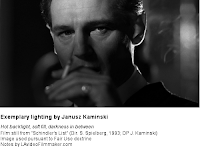 Depending on its position facing the figure, the key light will cause a shadow to be cast on a
characters body. Then the fill light is usually a light of lower key that is used to fill in this shadow to ensure that their whole face for example can be seen on video. Sometimes the use of a fill light will not be necessary as the key light is positioned nearer to the camera lens, this is very common in fashion photography whereby a ring flash is utilised, or the shadow on a character is intentional. Sometimes the fill light will have different hue to the key light which would be used to imply mood.
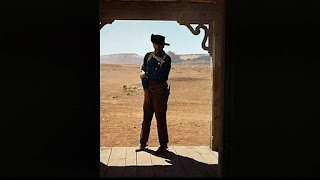
3. The Back Light
The Backlight is the light in which will usually be positioned behind an object or character in order to illuminate them and hence set them apart from their backgrounds. This illumination can create a silhouette of the character. A notable and iconic cinematic use of backlight is evident in John Ford's western The Searchers (Left). This porch doorway shot has been copied and referenced in many films since.
Butterfly Lighting
The butterfly effect is a lighting setup commonly used in fashion photography to illuminate most of a subjects face. It was most prominently used to illuminate 1930's female hollywood film stars.
When creating this lighting setup, I positioned the model (Francesca Smith) to face the camera directly at eye level. The diffusing 'soft box' light was thus positioned slightly above the camera and faced the model at a slight 70/80 degree angle. This angle and position results in the butterfly effect; a small shadow underneath the nose of the subject thats shaped like a butterfly.
Edge Lighting
Edge Lighting illuminates just one half of a subjects face, leaving the other half in a shadow. This is not usually considered a general purpose lighting technique, however it can be used for many different reasons in film. The most common use for this type of chiaroscuro is to suggest a characters untrustworthiness or deceitfulness as the shadow would suggest another unknown "side" to their personality. This technique is created by facing the light at a 90 or 120 degree angle (the left or right side) to where the subject is facing.
Rembrandt Lighting
This technique is named after the dutch painter of the same name. This lighting technique is created by positioning the light source at about 45 degrees from where the subject is facing. It results in a small triangular shape of light underneath the eye of the shadow side of the face of the subject.
High Key Lighting
High key lighting simply refers to when a shot is overall a particularly high key of light. An obvious way to easily achieve this is to record outdoors on a well lit day. In my example I used a fluid head tripod to smoothly pan almost 360 degrees around, capturing the scenery of the college. This example used is in stark contrast to the low key lighting of the video bellow.
Low Key Lighting
Low Key Lighting (Backlight Silhouette) from Ethan Delaney on Vimeo.
In this clip, I intended to reference the backlight doorway shot in The Searchers. I illuminated my figures face with the use of a mobile phone screen. This is an example of framing within a shot. The doorway acts as the frame, this can add importance to a specific character.

Night time shoots can be one of the hardest kinds of lighting setups to master. In order to fully capture the action of the scene numerous different kinds of lighting setups must be incorporated. Lighting a scene at night is particularly difficult as it involves balancing the realism of a scenes lighting with capturing your particular shots well.

Standard Three-Point Lighting Setup

1. The Key Light
The Key Light is usually the most important light that a cinematographer will use to highlight a figures form and dimension. This is the light in which will primarily illuminate our characters' face for example. This light then allows us, the audience, to view the characters facial features and emotions. Without the fill light, a conversation between two characters, for example, will not be captured to its full extent and will hence have less of an impact on the story. The fill lights position can have an effect on the audiences view of the characters. A key light positioned to the side of a characters face will subsequently cast a dark shadow on the other. This shadow can have connotations of the character having something to hide or that they're likely to be untrustworthy and the villain of the story. A notable contrast between high and low key lighting in a scene such as this is referred to as chiaroscuro in art and photography.2. The Fill Light
 Depending on its position facing the figure, the key light will cause a shadow to be cast on a
 characters body. Then the fill light is usually a light of lower key that is used to fill in this shadow to ensure that their whole face for example can be seen on video. Sometimes the use of a fill light will not be necessary as the key light is positioned nearer to the camera lens, this is very common in fashion photography whereby a ring flash is utilised, or the shadow on a character is intentional. Sometimes the fill light will have different hue to the key light which would be used to imply mood.

3. The Back Light
The Backlight is the light in which will usually be positioned behind an object or character in order to illuminate them and hence set them apart from their backgrounds. This illumination can create a silhouette of the character. A notable and iconic cinematic use of backlight is evident in John Ford's western The Searchers (Left). This porch doorway shot has been copied and referenced in many films since.
Butterfly Lighting
The butterfly effect is a lighting setup commonly used in fashion photography to illuminate most of a subjects face. It was most prominently used to illuminate 1930's female hollywood film stars.
When creating this lighting setup, I positioned the model (Francesca Smith) to face the camera directly at eye level. The diffusing 'soft box' light was thus positioned slightly above the camera and faced the model at a slight 70/80 degree angle. This angle and position results in the butterfly effect; a small shadow underneath the nose of the subject thats shaped like a butterfly.
Edge Lighting
Edge Lighting illuminates just one half of a subjects face, leaving the other half in a shadow. This is not usually considered a general purpose lighting technique, however it can be used for many different reasons in film. The most common use for this type of chiaroscuro is to suggest a characters untrustworthiness or deceitfulness as the shadow would suggest another unknown "side" to their personality. This technique is created by facing the light at a 90 or 120 degree angle (the left or right side) to where the subject is facing.
Rembrandt Lighting
This technique is named after the dutch painter of the same name. This lighting technique is created by positioning the light source at about 45 degrees from where the subject is facing. It results in a small triangular shape of light underneath the eye of the shadow side of the face of the subject.
High Key Lighting
High key lighting simply refers to when a shot is overall a particularly high key of light. An obvious way to easily achieve this is to record outdoors on a well lit day. In my example I used a fluid head tripod to smoothly pan almost 360 degrees around, capturing the scenery of the college. This example used is in stark contrast to the low key lighting of the video bellow.
Low Key Lighting
Low Key Lighting (Backlight Silhouette) from Ethan Delaney on Vimeo.
In this clip, I intended to reference the backlight doorway shot in The Searchers. I illuminated my figures face with the use of a mobile phone screen. This is an example of framing within a shot. The doorway acts as the frame, this can add importance to a specific character.
Shutter Speed
 The shutter is like a small curtain in a camera. It quickly passes over the image sensor and thus only allows light to enter and be absorbed by the sensor for fractions of a second. The faster the shutter passes over, the darker the resulting image. Therefore a lighter image can be created by reducing the shutter speed. A shutter speed of 1/20 of a second for example, will allow more light into the sensor than a shutter speed of 1/40. The shutter in a digital camera is also primarily responsible for effecting the amount of blur in moving imagery. By increasing the shutter speed, the image is being taken so fast that the object in movement has travelled less distance for any blur to be noticeable in a picture.
Slow Shutter Speed 1/50s:
Slow Shutter Speed (1/50s) from Ethan Delaney on Vimeo.
In this video the shutter speed has been reduced to 1/50 of a second. As you can see in the clip, the movement of the light bulb is slightly blurred. The quality of the images captured are therefore lower than in the higher shutter speed video.
I used the rule of ensuring the shutter speed of my camera is faster than the reciprocal of the focal length value (50mm) in order to avoid camera shake which would have resulted in my tests being rendered useless. A shutter speed of 1/50 was also chosen as this is the minimum speed required when previewing moving imagery at 24fps.
High Shutter Speed 1/160s:
Fast Shutter Speed (1/160s) from Ethan Delaney on Vimeo.
In this video the image quality is arguably better despite the higher amount of digital grain than the video above. This grain is the result of the fact that due to the higher shutter speed, less light was able to be taken in by the image sensor, in order to make up for this I had to adjust the ISO and Aperture accordingly to ensure the overall light level was equal to the video above.
Friday, 9 October 2015
Peter Biskind's 'Easy Riders, Raging Bulls: How the Sex-Drugs-And-Rock 'N' Roll generation saved Hollywood'
Bonnie and Clyde
'Bonnie and Clyde came out in the middle of the sexual revolution, and its real originality lays in the fact that it recognised that in America, fame and glamour are more potent than sex.' page 48
'Moreover, from the moment Clyde introduces himself and his partner, saying, "I'm Clyde Barrow and this is Miss Bonnie Parker. We rob banks", the movie brazenly romanticises the outlaws – bank robbers and killers.' page 49
'Bonnie and Clyde came out in the middle of the sexual revolution, and its real originality lays in the fact that it recognised that in America, fame and glamour are more potent than sex.' page 48
'Moreover, from the moment Clyde introduces himself and his partner, saying, "I'm Clyde Barrow and this is Miss Bonnie Parker. We rob banks", the movie brazenly romanticises the outlaws – bank robbers and killers.' page 49
An Introduction to the American New Wave
An introduction to the American New Wave from 1969 - '73
I am going to be studying the american new wave from the years of 1969 to 1973. This was the era in which the wave broke through to American mainstream cinema with films such as The Graduate and Easy Rider. The Films that I will be studying in particular are Easy Rider, &
I am going to be looking at the social conditions of the production of these films and their cultural impact.
I am going to be studying the american new wave from the years of 1969 to 1973. This was the era in which the wave broke through to American mainstream cinema with films such as The Graduate and Easy Rider. The Films that I will be studying in particular are Easy Rider, &
I am going to be looking at the social conditions of the production of these films and their cultural impact.
Monday, 5 October 2015
The American New Wave Resources
Resources:
Videos:
https://www.youtube.com/watch?v=7emBSfwbgro
The Rules in Editing French and American New Wave - https://www.youtube.com/watch?v=UTeOhlva3k0
Books:
Videos:
https://www.youtube.com/watch?v=7emBSfwbgro
The Rules in Editing French and American New Wave - https://www.youtube.com/watch?v=UTeOhlva3k0
Trends of American New Wave Cinema - https://www.youtube.com/watch?v=IkLjmwz942Y
The Influence of the French New Wave - https://www.youtube.com/watch?v=f9X4p74jHoo
Easy Rider - https://www.youtube.com/watch?v=00FWUfHaiU8
The Graduate - https://www.youtube.com/watch?v=VhrkzsflaQU
Websites:
http://www.newwavefilm.com/international/american-new-wave.shtml
http://www.newwavefilm.com/international/new-hollywood.shtml
http://www.newwavefilm.com/international/new-hollywood2.shtml
- Peter Biskind's book 'Easy Riders, Raging Bulls: How the Sex-drugs-and Rock 'n' Roll Generation Changed Hollywood': 'Bonnie and Clyde came out in the middle of the sexual revolution, and its real originality lays in the fact that it recognised that in America, fame and glamour are more potent than sex.' page 48 'Moreover, from the moment Clyde introduces himself and his partner, saying, "I'm Clyde Barrow and this is Miss Bonnie Parker. We rob banks", the movie brazenly romanticises the outlaws – bank robbers and killers.' page 49 Notable directors profiled in the book:
Steven Spielberg
Martin Scorsese
George Lucas
Francis Ford Coppola
Terrence Malick
Roman Polanski - The Age of New Waves: Art Cinema and the Staging of Globalization by James Tweedie
Biskind, Peter (1990). - The Godfather Companion: Everything You Ever Wanted To Know About All Three Godfather Films (HarperPerennial)
- Belton, John (1993). American Cinema/American Culture. New York: McGraw/Hill.
- Berliner, Todd (2010). Hollywood Incoherent: Narration in Seventies Cinema. Austin, TX: University of Texas Press.
- Cook, David A, “Auteur Cinema and the film generation in 70s Hollywood”, in The New American Cinema by Jon Lewis (ed), Duke University Press, New York, 1998, pp. 1–37
- Harris, Mark (2008). Pictures at a Revolution: Five Movies and the Birth of the New Hollywood. New York: The Penguin Press.
- James, David E, Allegories of Cinema: American Film in the Sixties, Princeton University Press, New York, 1989, pp. 1–42
- Kael, Pauline "Bonnie and Clyde" in, Pauline Kael, For Keeps (Plume, New York, 1994) pp. 141–57.
- Kael, Pauline, "Trash, Art, and the Movies", Going Steady: Film Writings 1968–69, Marion Boyers, New York, 1994, pp. 87–129
- Kanfer, Stefan, The Shock of Freedom in Films, Time Magazine, Dec 8 1967, Accessed 25 April 2009, http://www.time.com/time/magazine/article/0,9171,844256-7,00.html
- King, Geoff (2002). New Hollywood Cinema: An Introduction. London: I.B. Tauris. ISBN 9781860647499.
- Kirshner, Jonathan, Hollywood's Last Golden Age: Politics, Society, and the Seventies Film in America, Ithaca: Cornell University Press, 2012. ISBN 978-0801478161
- Krämer, Peter (2005). The New Hollywood: From Bonnie And Clyde To Star Wars. Wallflower Press. ISBN 978-1-904764-58-8.
- Monaco, Paul (2001). The Sixties, 1960–69, History of American Cinema. London: University of California Press.
- Schatz, Thomas (1993). "The New Hollywood". In Jim Collins, Hilary Radner and Ava Preacher Collins. Film Theory goes to the Movies. New York: Routledge. pp. 8–37.
- Thompson, Kristin & Bordwell, David (2003). Film History: An Introduction (2nd ed.). McGraw–Hill.
Potential Films:
MASH
Easy Rider
The Godfather
MASH
Easy Rider
The Godfather
Bonnie and Clyde
The Graduate
Patton
Taxi Driver
Platoon
Videos:
https://www.youtube.com/watch?v=7emBSfwbgro
The Rules in Editing French and American New Wave - https://www.youtube.com/watch?v=UTeOhlva3k0
https://www.youtube.com/watch?v=7emBSfwbgro
The Rules in Editing French and American New Wave - https://www.youtube.com/watch?v=UTeOhlva3k0
Trends of American New Wave Cinema - https://www.youtube.com/watch?v=IkLjmwz942Y
The Influence of the French New Wave - https://www.youtube.com/watch?v=f9X4p74jHoo
Hollywood Warfare: How the Pentagon Censors the Movies - https://www.youtube.com/watch?v=_NoFTpDzQZs
Operation Hollywood: How The Pentagon Shapes & Censors The Movies - https://www.youtube.com/watch?v=FPZL5WTilRE
https://www.youtube.com/watch?v=c9kpUW5mwZ8
Websites:
http://www.newwavefilm.com/international/american-new-wave.shtml
http://www.newwavefilm.com/international/new-hollywood.shtml
http://www.newwavefilm.com/international/new-hollywood2.shtml
The Relationship between Hollywood and The pentagon
http://america.aljazeera.com/articles/2014/7/29/hollywood-and-thepentagonarelationshipofmutualexploitation.html
Rules of Editing: http://www.lavideofilmmaker.com/filmmaking/film-editing-tips.html
The Psychology of film editing: https://www.youtube.com/watch?v=FinhQb3jiAs
Taxi Driver:
https://en.wikipedia.org/wiki/Taxi_Driver
The Graduate:
https://en.wikipedia.org/wiki/The_Graduate
1960's Berkeley Protests - https://en.wikipedia.org/wiki/1960s_Berkeley_protests#cite_ref-gales_2-0
4 hour Film Task
The">https://vimeo.com/141150894">The Conversation
from Jakob">https://vimeo.com/user43481888">Jakob Morrison on Vimeo.https://vimeo.com">Vimeo.>
On 1st October, our HNC group (Francesca Smith, Lalita Ajit, Jessica Barratt, Beth Heath, Katie Tooth and myself) were set with the task of creating a short film within a four hour time-frame of the days' scheduled lessons. This would include the conjuring up of a plot, production of cinematic shots and editing them together ready to present the following day in class. In order to inspire our creativity, we were set with the limitation of our films being titled "The Conversation" and the plot being related to just that, whichever way we decided that would be a part of the film.
We were advised by our teachers to assign ourselves to a specific creative role. However, this assignment did not take place because of uncomfortable open discussion within our group. Its my belief that our initial lack of group cohesion was due to a lack of working on prior tasks together before this project.
Instinctively, I felt that I would best suit the role of the Cinematographer due to my previous study of film at A Level that other team members did not have the experience of doing. On the other hand, numerous members of the team had taken photography courses which meant that they were better suited to operating the DSLR cameras. In post-production, this became evident to me by the apparent variation in quality of the footage. Towards the end of our film, during which I was not the camera operator, the quality is noticeably superior as less digital noise and over/under-exposure is present. However, I also reason that this change in roles (of which allowed me to focus on editing the first half) caused the plot to become less of a focus and hence it became unclear to the audience. This uncertainty was later expressed by our classmates in reviewal of our film.
In conclusion, I believe a better-established direction and assignment of clear creative roles would have significantly improved our film. A struggle between which direction to take the production and overall un-organisation caused a significant amount of time at the beginning of the shooting to be lost.
Subscribe to:
Posts (Atom)